Article: Real, Repainted or Fake? How to Check a Hot Wheels Before You Pay
Real, Repainted or Fake? How to Check a Hot Wheels Before You Pay
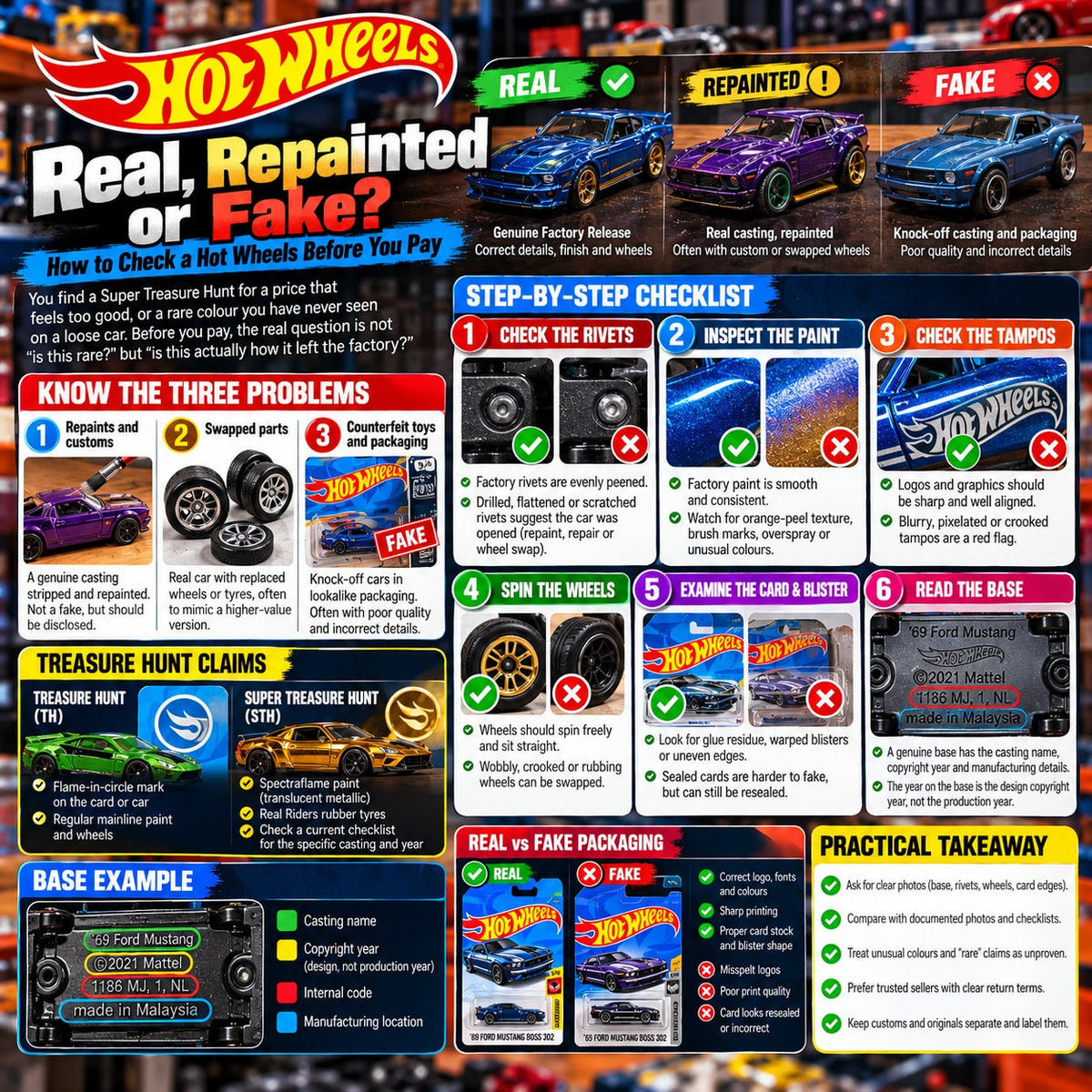
You find a Super Treasure Hunt for a price that feels too good, or a rare colour you have never seen on a loose car. Before you pay, the real question is not "is this rare?" but "is this actually how it left the factory?" Repainted cars, swapped wheels and resealed cards are a known hazard of the hobby, and the checks to catch them are mostly cheap and visual.
Why this question keeps coming up
Searches such as "how to tell if a Hot Wheels has been repainted" and "how to spot fake Hot Wheels" return a steady stream of collector guides, which tells you the worry is common. A caveat worth stating up front: many of those guides are published by sellers or authentication services, so they have a commercial interest in making the problem sound large. We did not find a news report documenting a surge of fakes in 2026, so treat this article as a careful-buyer checklist, not an alarm.
First, know the three different problems
1. Repaints and customs
A genuine Hot Wheels casting that someone has stripped and repainted, often in a colour that sells for more. These are not counterfeits of the brand, but they are misrepresented if sold as factory originals. Customising is a legitimate hobby when it is disclosed.
2. Swapped parts
Real car, replaced wheels or tyres. This matters most for Super Treasure Hunts, which are typically identified by Spectraflame paint and rubber Real Riders tyres, so a fake can be built by adding premium-looking wheels to an ordinary car.
3. Counterfeit toys and packaging
Knock-off cars sold in lookalike packaging. Guides commonly flag misspelt logos, missing base inscriptions (maker, country, year) and poor print quality.
The inspection checklist
Look at the rivets first
The two rivets on the base are the hardest thing to disguise. Factory rivets are evenly peened. Drilled, flattened, scratched or misshapen rivets suggest the car was taken apart, usually for a repaint, repair or wheel swap. A UK collectors' club article on spotting fake diecast notes that rivet damage is very hard to hide because opening the base is unavoidable for a full repaint.
Inspect the paint
Factory paint is smooth and consistent. Warning signs are orange-peel texture, brush marks, overspray on windows or trim, and colours that do not match any documented release of that casting. Spectraflame, the translucent metallic finish associated with Super Treasure Hunts, is described as hard to replicate, so a dull finish on a supposed STH deserves suspicion.
Check the tampos
Tampos are the printed graphics. On a real car they are sharp and well registered. Blurry, pixelated or crooked logos are a red flag, particularly when the rest of the car looks factory-fresh.
Spin the wheels
Swapped wheels can wobble, sit crooked or rub the fenders. If a car is advertised as having Real Riders, look for rubber tyres on plastic hubs and compare against photographed examples of the same casting.
Examine the card and blister
Glue residue, warped blisters and uneven edges can indicate a card has been opened and resealed. One guide also warns not to rely on packaging alone, because blister packs can be resealed or faked, while many genuine factory errors are found loose.
Read the base
A genuine base carries the casting name, a copyright year, and manufacturing details. Collectors often misread the year: it is generally the copyright date of the casting design, not the year the specific car was made. Never use the base year alone to date or authenticate a car.
Treasure Hunt claims need extra care
Hot Wheels introduced its Treasure Hunt series in 1995, according to the Hot Wheels Wiki. Modern guides describe the regular Treasure Hunt as carrying a flame-in-circle mark, while the Super Treasure Hunt usually combines Spectraflame paint and Real Riders tyres. Sources disagree on details such as the colour of the flame on the card and exactly when the "TH" graphic began, which is a good reminder to check any claim against a current community checklist for that specific casting and year. For a primer on what these labels mean, see our guide What Is a Chase Car? Hot Wheels Treasure Hunts and Super Treasure Hunts Explained.
Collector Perspective
No single tell proves a car is genuine or fake. A real collector builds a case from several signals: sound rivets, factory-looking paint, sharp tampos, correct wheels for that casting, and a seller who can show clear photos of the base. The reverse also holds: one odd detail does not condemn a car, because Mattel does produce genuine variations. When the evidence is mixed, price the car as if it were the cheaper, ordinary version. If the seller will not show the base, that is itself information.
Condition and originality interact with value in other ways too, which we cover in Loose vs. Carded: What Actually Determines a Diecast Model's Value.
Practical Takeaway
- Ask for sharp photos of the base, both rivets, the wheels and the card edges before paying.
- Compare the car with documented photos of the same casting and release year.
- Treat unusual colours and "rare" claims as unproven until a checklist or community database confirms them.
- Prefer sellers who sell on-card, sealed stock from known supply, and who state return terms clearly.
- Keep customs and originals separate in your collection and label customs honestly.
If you want to buy from a known source, browse our Official Die Cast collection or the wider Hot Wheels 1:64 collection.
Frequently Asked Questions
How can you tell if a Hot Wheels car has been repainted?
Check the rivets and the paint. Drilled, flattened or scratched rivets and orange-peel texture, brush marks or overspray on the windows usually indicate a repaint. Colours that match no documented factory release are another warning sign.
How do you spot a fake Hot Wheels?
Look at the packaging and the base. Fakes often have misspelt logos, blurry printing and bases without the usual inscriptions such as maker, country and year.
How can you tell a Super Treasure Hunt is real?
Super Treasure Hunts are typically recognised by Spectraflame paint and rubber Real Riders tyres, but both can be imitated or swapped. Verify the casting and year against a current community checklist and inspect the rivets for signs of opening.
Does the year on the base show when the car was made?
No. It is generally the copyright year of the casting design, not the production year of that particular car.
Is a repainted Hot Wheels worthless?
Not necessarily. A disclosed custom can be a worthwhile piece, but it should not be priced or described as a factory original.
Sources
- Hot Wheels Wiki, Treasure Hunt: hotwheels.fandom.com/wiki/Treasure_Hunt
- Muncle Mike's, collector guides on repainted and fake Hot Wheels: munclemikes.com (seller-published)
- Legit Check, fake vs real Hot Wheels diecast: legitcheck.app (authentication service)
- Collectors Club of Great Britain, How to spot fake diecast models: collectors-club-of-great-britain.co.uk