Article: The Tomica Story: How Japan's First Diecast Cars Reached 670 Million Sales
The Tomica Story: How Japan's First Diecast Cars Reached 670 Million Sales
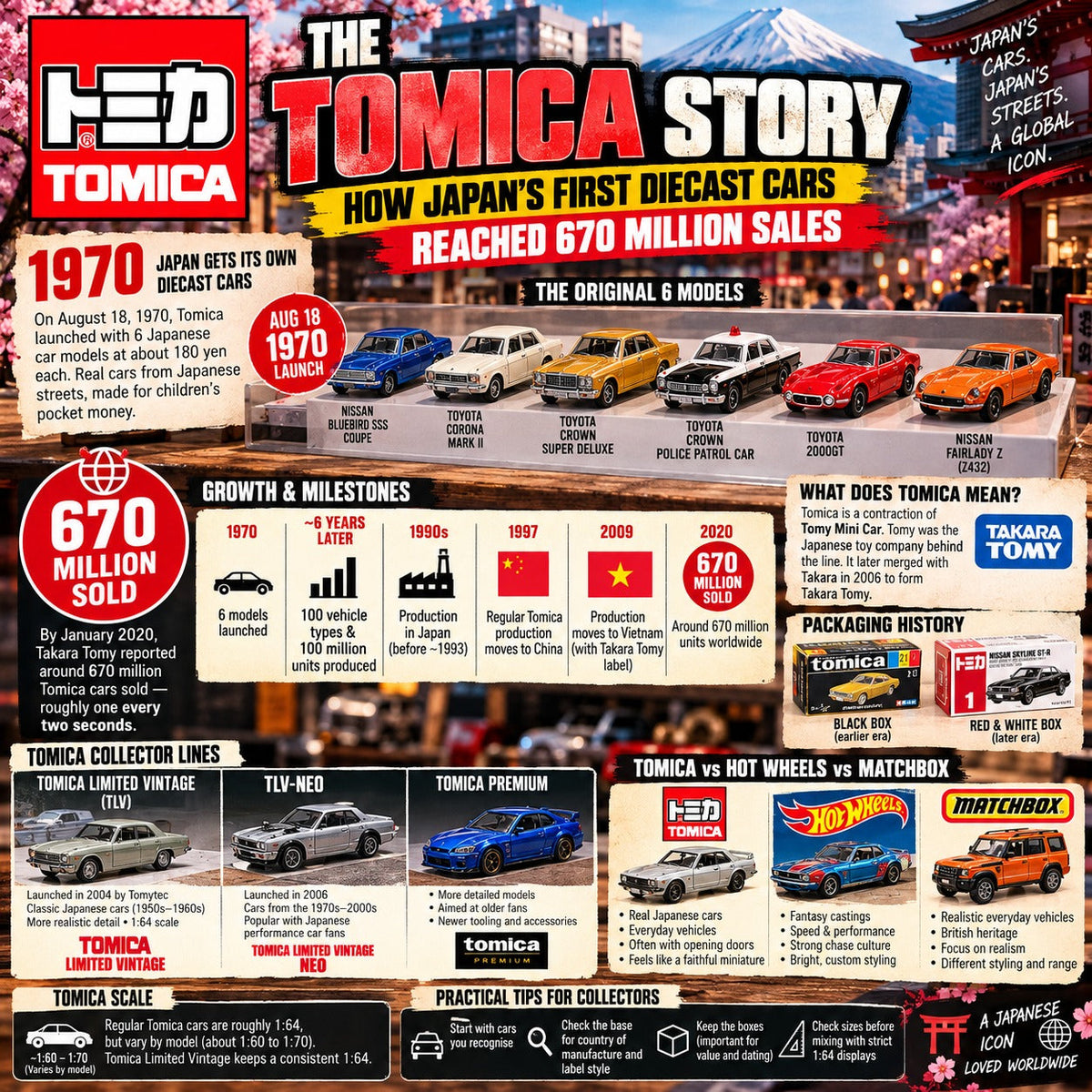
On August 18, 1970, six small Japanese cars went on sale in Japan. Nobody involved could have known that this modest launch would grow into one of the best-selling diecast lines on Earth. The line was Tomica, and by January 2020 Takara Tomy reported that around 670 million had been sold, which works out to roughly one every two seconds. If you collect 1:64 cars, you have probably held one without thinking about where it came from. This is that story.
What Does "Tomica" Actually Mean?
The name is a contraction of Tomy Mini Car. Tomy was the Japanese toy company behind the line. It later merged with Takara in 2006 to form today's Takara Tomy. The name carries no hidden meaning beyond the brand itself.
1970: Japan Gets Its Own Diecast Cars
By the late 1960s, small diecast cars were a global craze led by Matchbox and then Hot Wheels (we covered why Hot Wheels was created separately). Imported toy cars were popular in Japan, but they mostly showed foreign vehicles. Tomy's idea was simple: make realistic miniatures of the cars Japanese children actually saw on their own streets.
The first wave, released on August 18, 1970, contained six models:
- Nissan Bluebird SSS Coupe
- Toyota Corona Mark II
- Toyota Crown Super Deluxe
- Toyota Crown police patrol car
- Toyota 2000GT
- Nissan Fairlady Z (listed by some sources as the Fairlady Z432)
Sources describe the original retail price as about 180 yen per car. Tomica was aimed at children's pocket money rather than at adult collectors, and that shaped everything about the line's design and reputation.
Growth: From Six Cars to Hundreds of Millions
Tomica took off quickly. Company history summaries note that within about six years the range passed 100 vehicle types and production passed 100 million units. Real Japanese vehicles like police cars, taxis, fire engines, ambulances and buses filled out the range, which made it as much a miniature city as a car line.
Collectors tracing the line often mention its numbering system. Regular Tomica models carry a number in the lineup, and a separate "foreign" series ran F1 to F70 for non-Japanese cars. When some foreign models were later moved into the main series, they were reassigned numbers based on their F-number plus 80. Reading these numbers is one of the small pleasures of collecting the brand.
Where Tomica Has Been Made
Collector references describe several distinct production eras, which matters when you evaluate older pieces:
- Made in Japan with a red Tomy label: models made before roughly 1993.
- Made in China: regular Tomica production had moved to China by July 1997. A 2003 Subaru Legacy is generally cited as the last regular Tomica built in Japan.
- Made in Vietnam with the Takara Tomy label: from 2009 to the present.
Packaging also changed. Collectors talk about "black box" models and later red-and-white box models. Different references date the switches slightly differently, so check a dedicated catalogue before paying a premium for a specific vintage.
The Collector Tier: Tomica Limited Vintage
Tomica started as a toy, but collectors eventually got their own branch. In 2003 Tomy set up Tomytec as a specialised subsidiary, and in 2004 it launched Tomica Limited Vintage (TLV). The line focused on classic Japanese cars of the 1950s and 1960s, with more realistic paint, trim and emblems in a consistent 1:64 scale. In 2006 came TLV-Neo (TLV-N), extending the timeline to the 1970s and 1980s and later to the 1990s and 2000s. TLV-N is where many Japanese performance-car fans find the Skylines, Silvias and other cars they grew up admiring.
Tomica Premium is a further, more detailed line aimed at older fans. It uses newer tooling and more accessories than the standard range.
Tomica vs. Hot Wheels vs. Matchbox
All three sit at roughly the same size, but they feel different:
- Tomica emphasises real production cars and everyday vehicles, often with opening doors or a working suspension, and tends to feel like a faithful miniature.
- Hot Wheels leans into fantasy castings and speed, with a strong chase and Treasure Hunt culture.
- Matchbox focuses on realistic everyday vehicles too, but with its own British heritage.
Note that Tomica scale is not a strict 1:64. Many regular Tomica models are sized to the vehicle, so scales printed on the box typically fall somewhere around 1:60 to 1:70. This matters when you display them next to other brands. Our guide to diecast scales explains why "1:64" is more of a family than a fixed measurement.
Collector Perspective
What makes Tomica interesting to collect is its documentation. Numbers, box eras, country of manufacture and label colour let you date and classify a piece far more precisely than with many other brands. That also means condition and era matter: a vintage Made-in-Japan model in a good box is a different kind of object from a current Vietnam-made release, and prices in the secondary market reflect that. Discontinued or limited models can appreciate, especially in excellent condition, but treat any price expectation as a market observation, not a promise. For more on how condition drives value, read our piece on loose vs. carded models.
Practical Takeaway
- Start with cars you personally recognise. Tomica's strength is realism, so a favourite production car is a good first pick.
- Check the base of the car for the country of manufacture and the label style before assuming a model is "vintage."
- Do not mix Tomica into a strict 1:64 display without checking sizes; a bus or truck will look different from a hatchback.
- Keep boxes if you can. For Tomica especially, packaging is part of the dating evidence.
If you want to browse, The Peppy Store's Takara Tomy Tomica collection lists the current models, and the wider Official Die Cast collection covers other licensed brands. Availability changes, so check the collection pages for what is in stock.
Frequently Asked Questions
When was Tomica launched?
Tomica launched on August 18, 1970, with six Japanese car models, and it is generally described as Japan's first domestically produced diecast miniature car series.
What does Tomica stand for?
Tomica is short for "Tomy Mini Car." Tomy was the toy maker that created it and later merged with Takara in 2006.
What scale is Tomica?
Regular Tomica cars are roughly 1:64, but the exact scale varies by model, typically between about 1:60 and 1:70. Tomica Limited Vintage keeps a consistent 1:64.
What is Tomica Limited Vintage (TLV)?
TLV is a collector-oriented Tomica line launched by Tomytec in 2004, focusing on realistic Japanese cars, first from the 1950s and 1960s, and from 2006 in the TLV-Neo series, from later decades.
Where is Tomica made today?
Current regular Tomica models are made in Vietnam, following earlier production in Japan and then China. The last regular Tomica built in Japan is generally cited as a 2003 model.
Is Tomica the same as Hot Wheels?
No. Tomica is a Japanese brand from Takara Tomy, launched in 1970. Hot Wheels is made by Mattel and launched in 1968.
Sources
- Tomica (toy line), Wikipedia
- Takara Tomy press release, Tomica 50th anniversary (PDF)
- 50 Year Club: Tomica, Japanese Nostalgic Car
- Tomica Toy Cars, AutoTrader Canada
- Tomica Wiki (fan reference for numbering and production eras)
- Lamley Group, Tomica Premium coverage
Figures such as sales totals, pricing and production-era dates come from the sources above and may be described slightly differently elsewhere.