Article: Is Your Old Hot Wheels Collection Worth Anything? 7 Myths Collectors Still Believe
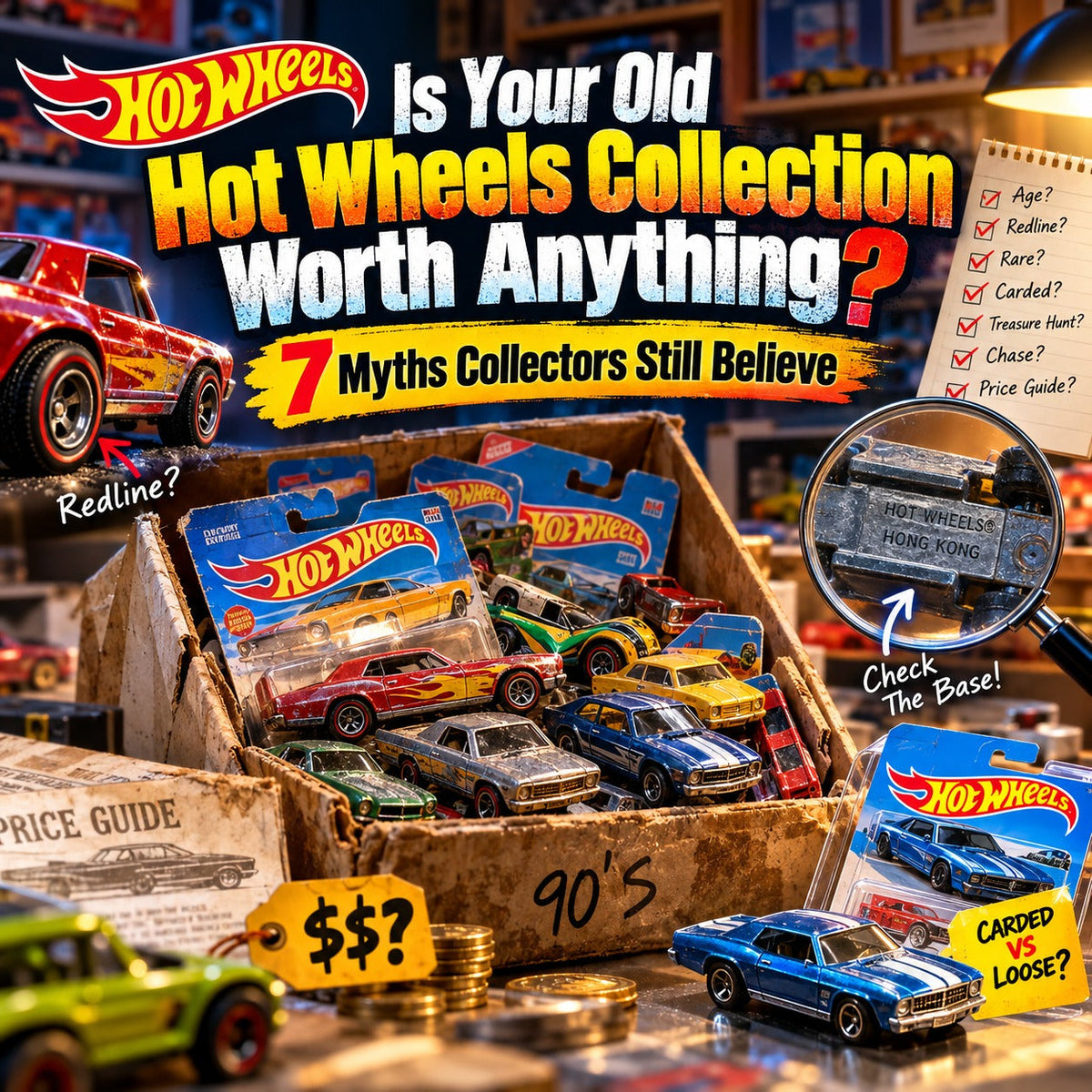
Is Your Old Hot Wheels Collection Worth Anything? 7 Myths Collectors Still Believe
Almost every collector has had the same conversation: someone finds a box of old toy cars in a cupboard and asks, “These are from the 90s — they must be worth a fortune, right?” Sometimes the answer is yes. Far more often it is “a little, maybe.” Searches like “are old Hot Wheels worth money” keep coming up for exactly this reason, and the honest answer has more nuance than most listings suggest.
Here are seven myths that still circulate in the hobby, and what the evidence says about each.
Myth 1: “If it is old, it is valuable”
Age alone is not what collectors pay for. Price guides consistently say that value depends on the specific casting, colour, condition and whether the car is original. Millions of mainline cars were produced over decades, and most of them are common.
One analysis of 23,483 single-piece Hot Wheels sales between July and October 2026 reported a median sale price of $12.95, with the middle half of sales between $5.50 and $33.99. Only about 8% of single pieces sold for $100 or more, and those high-end sales were mostly vintage Redlines rather than modern cars. This is one analysis of one marketplace, so treat the numbers as indicative, but the shape matches what long-time collectors describe: a huge base of inexpensive cars and a thin top tier.
Myth 2: “Any car with a red stripe on the tyre is a Redline worth thousands”
Hot Wheels launched in 1968, and the original “Redline” cars are those from the earliest years, identified by the red stripe on the tyre sidewall. Sources differ slightly on the exact cut-off (commonly given as around 1977, roughly the first eight or nine years). Two cautions apply:
- Hot Wheels brought red-line tyres back on later releases, so the stripe alone does not date a car.
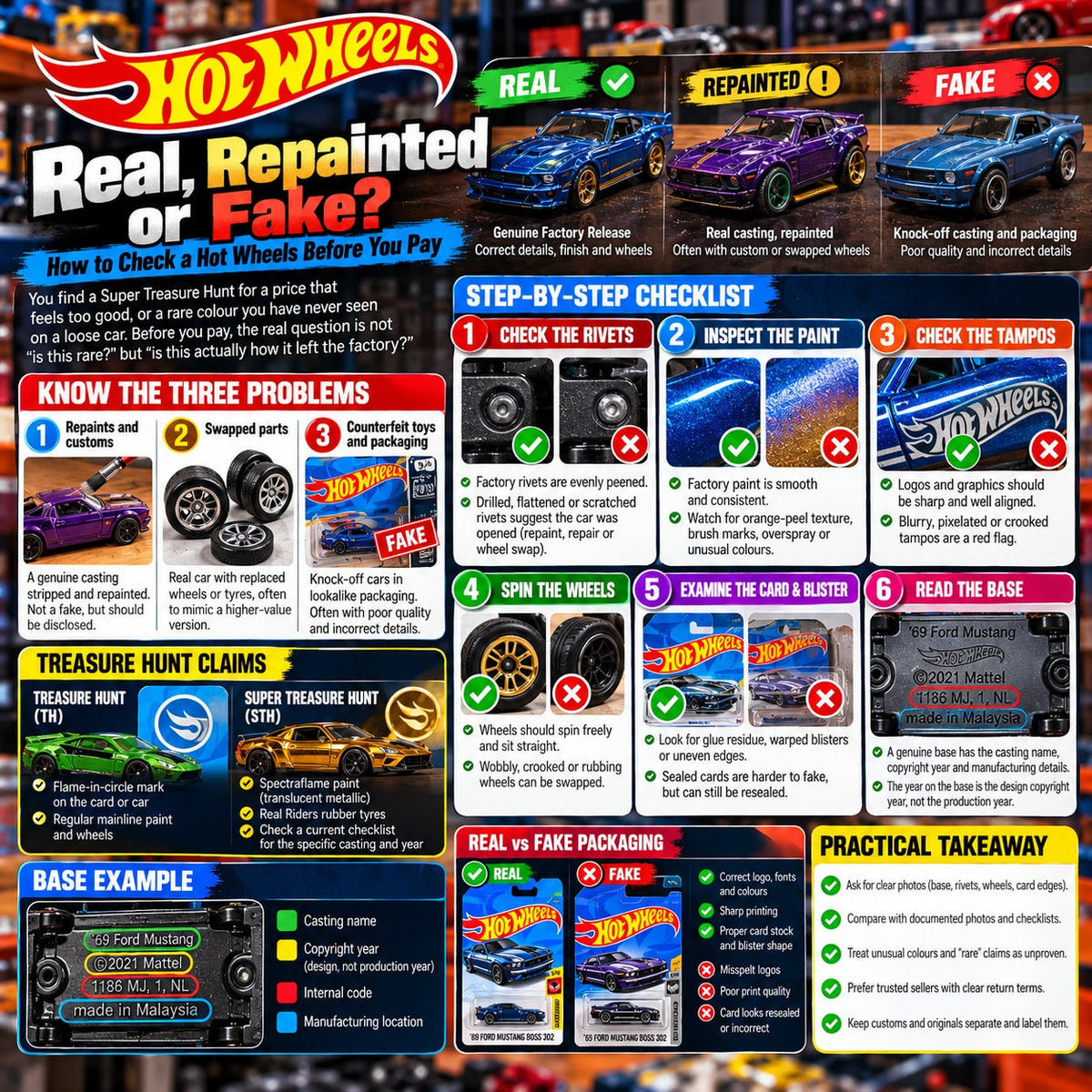
- Reproductions with a red stripe exist, so a genuine Redline needs to be checked against its base markings, such as the country of manufacture (the US or Hong Kong for early cars).
Our guide on how to check a Hot Wheels before you pay covers the practical checks for repaints and fakes.
Myth 3: “A famous rare car means my car is that rare car”
The pink 1969 Beach Bomb prototype is the usual headline example, with one source reporting a sale of around $175,000. That is a prototype of exceptional rarity, not a benchmark for ordinary Redlines. Quoting it against a common casting is the quickest way to set unrealistic expectations.
Myth 4: “Opening the package does not change the value”
For most modern cars it does. One collector guide puts carded examples at roughly two to three times the value of the same car loose, though the multiple varies by casting and demand. Card condition, blister clarity and corners all matter. We break down the logic in Loose vs. Carded: What Actually Determines a Diecast Model’s Value.
That said, plenty of collectors open everything. If you buy to display and enjoy, a loose car is a perfectly valid choice — just do not expect packaging-level resale later.
Myth 5: “Every Treasure Hunt is a jackpot”
Mattel introduced Treasure Hunts in 1995 as a 12-car adult-collector series, and Super Treasure Hunts followed in 2007, distinguished by features such as Spectraflame paint and Real Riders wheels and by much smaller production. Since then both have moved into the regular mainline assortment as hidden finds. Super Treasure Hunts tend to hold interest; regular Treasure Hunts vary widely by casting and year. For the identification details, see What Is a Chase Car?
Myth 6: “Chase and limited cars always go up”
2026 offers a useful reality check. Autoevolution’s coverage of the 2026 Car Culture releases quotes one collector saying the market “has been dead for six months,” and mentions resellers trying to move a Vintage Racing set for as little as $40. That is one commenter’s view, not market data, and other 2026 chases were reported selling for far more (one reviewer cited $80–$300 for a 2026 Datsun 510 Wagon chase). The takeaway is not that the hobby is collapsing; it is that “limited” and “valuable” are different things, and prices swing with hype.
Myth 7: “Price guides tell you what your car will sell for”
Guides and asking prices are opinions; sold listings are evidence. Many guide sites are also run by sellers, so their numbers can lean optimistic. Compare several recent sold results for the same casting, colour and condition before deciding anything.
Collector Perspective
Experienced collectors tend to separate two hobbies that look identical from the outside. One is collecting for love — a favourite car brand, a childhood casting, a theme. The other is collecting for resale, which behaves more like a small market with fees, fakes and fashion cycles. The people who stay happiest longest are usually in the first group and treat any appreciation as a bonus. In India, where official releases and cases arrive on different timelines than in the US, that mindset also keeps you from overpaying during a hype window.
Practical Takeaway
- Identify the exact casting, year and colour from the base and card before looking up any value.
- Check sold listings, not asking prices, and note the condition.
- Keep original packaging if resale matters to you; open freely if it does not.
- Be sceptical of any car described as “rare” without a source.
- Buy the cars you would still enjoy owning if their price never moved.
If you are building a display rather than a portfolio, browse the Official Die Cast collection and pick by what you like.
Frequently Asked Questions
Are old Hot Wheels worth money?
Sometimes, but not automatically. Value depends on casting, colour, condition, originality and demand. Most mainline cars, even decades old, sell for modest amounts; the high values are concentrated in early Redlines and rare variants.
How do I know if my Hot Wheels car is valuable?
Identify the casting and year from the base, check for variations such as colour and wheels, assess condition and packaging, then compare recent sold listings for the same car. Asking prices alone are unreliable.
What is a Redline Hot Wheels car?
A Redline is an early Hot Wheels car with a red stripe on the tyre, produced from the brand’s 1968 launch until roughly the late 1970s (sources vary on the exact cut-off). Red-line tyres were reused later, and reproductions exist, so check the base markings.
Is a carded Hot Wheels worth more than a loose one?
Usually yes. One collector guide estimates carded cars at two to three times the loose value, depending on the car and card condition.
Is the Hot Wheels collector market down in 2026?
Evidence is mixed and mostly anecdotal. Some collectors report weak resale on certain 2026 Car Culture sets, while other chases still sell well. No reliable index confirms a market-wide decline.
Sources
- Autoevolution, coverage of the 2026 Hot Wheels Car Culture and chase releases (autoevolution.com)
- Underpriced AI, “Hot Wheels Sold Prices 2026: What 23,483 Single Pieces Went For” (underpricedai.com)
- Muncle Mike’s, Hot Wheels Treasure Hunt and Super Treasure Hunt guides (munclemikes.com)
- HotCars, “How to know if your Hot Wheels cars are valuable” (hotcars.com)
- Collectinsure, “Are Hot Wheels Worth the Investment?” (collectinsure.com)
- Redline price guide, PCTechMag, June 2026 (pctechmag.com)